Search This Blog

Monday, February 13, 2006

Chemicals 'affect child brains'

Man-made chemicals are affecting the development of children's brains, a report has suggested.

The World Wildlife Fund (WWF) warns substances in everyday goods such as TVs, computers and car seats can affect children's memory and IQ.

WWF reviewed the latest research into the effects of chemicals on children's development.

The organisation has called for more information about the potential effects of chemicals.

The WWF said even a minor impact on intelligence levels could affect a child's life.

It cited research showing the loss of one IQ point can be associated with a reduction in lifetime earnings of over 2%,

Its report, Compromising our Children, also warned EU research had found chemicals in products could also alter a child's visual recognition, movement skills.

Power stations

There are an estimated 70,000 man-made chemicals currently on the market.

US researchers have estimated that up to 10% of all neurobehavioural disorders are caused by toxic exposures.

The WWF says that, in addition to dangerous levels of Deca brominated diphenyl ether (Deca-BDE) flame retardants in everyday objects, contaminates, known as PolyChlorinated Biphenyls (PCB) also pose a risk.

These chemicals leech from old industrial transformers, and some building materials.

Prenatal exposure to PCBs has been linked to less masculine play in boys - but more masculine play in girls.

Dioxins emitted by power station and some factories and open burning of some plastic wastes are another threat.

The European Commission has said the occurrence of developmental and learning disabilities as a "significant public health problem".

But the WWF believes that most chemicals on the market do not carry sufficient safety information - particularly about their ability to cause developmental problems.

'Future under threat'

Gwynne Lyons, WWF toxics adviser, said: "In effect we are all living in a global chemical experiment of which we don't know the outcome.

"Our children are our future - and our future is under threat.

"It seems unbelievable that although science has shown that chemicals are affecting children's mental abilities and their ability to make sense of their world, we are still missing vital safety data on most chemicals in use today."

Tuesday, February 07, 2006

INDUSTRIA ROMÂNEASCĂ DE PROCESARE A CĂRNII - VICTIMĂ A INTEGRĂRII EUROPENE

Marius Mioc [Toate articolele acestui autor]

DIN 32 de firme din judeţul Timiş care se ocupă cu procesarea cărnii şi laptelui, numai una îndeplineşte normele europene, aflăm dintr-un articol publicat de „Evenimentul Zilei - ediţia de Vest” din 1 februarie 2006. Pentru un abator, investiţia minimă necesară conformării la standardele europene este 3 milioane euro, scrie ziarul. „Creşterea porcilor în gospodăriile ţărăneşti se va permite doar pentru consumul familiei (…) Ţăranilor li se va interzice însă să comercializeze carnea porcilor din propria bătătură”, mai sîntem informaţi.

Aşadar, aceasta este economia de piaţă în concepţia Uniunii Europene: nu e vorba de libera competiţie între firmele multinaţionale şi micii producători, în care cel mai eficient din punct de vedere economic cîştigă, ci de eliminarea de pe piaţă a micilor producători, prin norme birocratice croite înadins pentru a fi imposibil de respectat de micii producători. Demagogic se invocă protecţia consumatorilor, de parcă fără o investiţie de 3 milioane euro nu se poate sacrifica un animal în condiţii igienice. Ţăranilor sau micilor întreprinzători li se va interzice vînzarea cărnii nu doar în cazurile în care, la o analiză sanitară, reiese că marfa are probleme, ci ca principiu: trebuie să le intre în cap că nu e de nasul lor să facă concurenţă firmelor multinaţionale. Cu îngăduinţă, ţăranul e încă lăsat să-şi crească porc pentru propria sa familie, dar cu condiţia ca sacrificarea acestuia să se facă tot la abatorul firmei multinaţionale, la preţul pe care aceasta îl stabileşte (la 3 milioane euro investiţie minimă, nu vor fi prea multe abatoare, deci nici competiţie în acest domeniu economic).

În ceea ce priveşte exportul, s-a rezolvat deja, autorizaţie de export are numai cine trebuie: „Singurul abator [din judeţul Timiş - nota mea] care întruneşte toate standardele şi este autorizat să facă export este Agrotorvis SRL, aparţinînd companiei americane Smithfield Foods Inc.”. Trebuia însă rezolvată problema pieţii interne româneşti, unde prea mulţi bani rămîneau în mîna românilor. A învinge micii producători români doar prin raportul calitate/preţ a produselor este imposibil, dar marile firme au un aliat în această luptă economică: Statul.

Firească va fi creşterea preţurilor la produsele alimentare, imediat după integrarea în UE. Cine a investit 3 milioane euro într-un abator va avea pretenţia să-şi recupereze investiţia. Statul, cu întreaga forţă de constrîngere a aparatului poliţienesc şi birocratic, va asigura eliminarea celor care ar putea face concurenţă investitorilor (în majoritate străini, dar şi unii mari bogătaşi români): inspectorii sanitar-veterinari vor închide abatoarele care „nu respectă standardele”, poliţiştii şi jandarmii vor face controale în pieţe, ca nu cumva să vîndă cineva neautorizat, instanţele judecătoreşti îi vor pedepsi pe cei care nu respectă regulile. Iar noi, românii de rînd, vom scoate mai mulţi bani din buzunar pentru mîncare, sau ne vom învăţa să mîncăm mai puţin.

A MURIT CREATOAREA FEMINISMULUI MODERN

FONDATOAREA MISCARII feministe postbelice americane, Betty Friedan, a incetat din viata ieri, la varsta de 85 de ani, in urma unei crize cardiace.

Friedan, pe numele adevarat Naomi Goldstein, in prima sa tinerete propagandista bolsevica, a devenit cunoscuta in 1963 prin cartea “The Feminine Mystique”, care a marcat inceputul unei miscari menite sa distruga piatra de temelie a societatii: familia nucleara, heterosexuala, prin asa-zisa “reevaluare a rolului femeii in societatea americana”. Prin atacarea ordinii sociale, feministele au cauzat mult rau, avand o mare contributie la aprinderea scanteii razboaielor culturale ce au polarizat societatea americana.

Feminismul promoveaza agresiv avortul, incurajand femeile sa urmareasca sexul si cariera si nu implinirea prin familie. Consecintele sunt catastrofale in special in SUA, unde rata nasterilor a cazut de la 3,9 copii per femeie in 1960 la 2 astazi, un minim istoric (rata de inlocuire este de 2,1). Rata casatoriilor a scazut cu o treime, in timp ce numarul divorturilor s-a dublat din 1960. Mai mult de jumatate din primii copii ai femeilor americane sunt conceputi sau nascuti in afara casniciei.

Cei interesati sunt invitati sa reciteasca articolul “Mommie was a commie” despre Betty Friedman, semnat de Henry Makow si republicat de Altermedia. (BIS)

Monday, February 06, 2006

Când tinerii sunt păcăliţi de satanism

11.09.2001, Roma (ZENIT)

"Tineretul şi Esoterismul", un best-seller despre satanism şi impactul lui asupra tinerilor, este scrisă de un jurnalist în încercarea de a aduce o clarificare în acest domeniu. Lucrarea, care de patru luni este pe primul loc ca vânzare în librăriile catolice italiene, este publicată de Surorile Pauline. Săptămâna aceasta cartea a apărut şi în Portugalia. În curând va fi tradusă pentru a fi publicată în Spania, şi în câteva luni şi în Polonia.

Cartea se concentrează asupra aspectelor care privesc în special pe tineri, adesea neînţeleşi de adulţi. Este zidul pe care scriitorul şi jurnalistul Carlo Climati doreşte să îl dărâme. Esoterismul în rândul tinerilor este un fenomel mondial, arată un articol din 28 august din publicaţia londoneză The Times, în care este subliniată proliferarea siturilor satanice de pe Internet. În Marea Britanie doar, există peste 1.000 de secte sau culte satanice sau mişcări spiritiste, se mai spune în articol.

În acest interviu, Climati explică de ce tinerii sunt atraşi de ocultism.

- Despre ce este lucrarea "Tineretul şi Esoterismul"?
- Este o anchetă asupra tendinţelor esoterice ale noilor generaţii. Începe cu patru interviuri cu tineri care au reuşit să scape din capcana esoterismului, spiritismului, magiei şi satanismului. În continuare sunt analizate aspecte curente: rockul satanic, discotecile, secretele esoterice ale tatuajelor şi body piercing-ului, New Age-ul, lumea Internetului, spectacolele de televiziune cu magicieni, serialele cu conţinut esoteric, jocurile, desenele animate japoneze, etc. Există chiar un mic dicţionar de termeni esoterici şi o bibliografie bogată.

- Credeţi că interesul băieţilor şi fetelor relativ la estorism a crescut în ultimii ani?
- Da. Anul trecut, în Chiavenna, Italia, trei tinere fete au ucis o călugăriţă înjunghiind-o de 19 ori ca un fel de "jertfă" adus răului. Simboluri demonice şi fraze din rockul satanic se găsesc peste tot în jurnalele lor.

Interesul tineretului în esoterism, satanism şi spiritism a crescut foarte mult. Astăzi, horoscopurile, amuletele, cărţile de tarot şi şedinţele spiritiste sunt principalele moduri prin care tinerii devin victime ale bombardamentului esoteric, dus printr-o mare diversitate de mijloace: de la muzică, televiziune, jocuri, la cinematografe şi discoteci.

- Cum are loc acest "bombardament"?
- Este un bombardament care îşi găseşte un teren fertil în vieţile a multor tineri, adesea caracterizaţi de o profundă singurătate, situaţii familiale dificile şi nesiguranţă asupra viitorului. Interesul în esoterism, propus ca soluţie imediată la problemele de zi cu zi, pot provoca un dezastru pentru minţile băieţilor şi fetelor. Poate contribui la crearea unei generaţii de "noi sclavi", închişi în chiar comportamentul lor.

Horoscopurile, magia, şedinţele spiritiste şi rockul satanic aduc milioane de dolari. Este o afacere care îi duce pe unii la îmbogăţire pe seama tineretului, atrăgându-i în astfel de "capcane".

- Cum se răspândeşte virusul esoterismului? Care este cauza epidemiei esoterice care a infestat tinerele generaţii?
- Totul vine dintr-o mare greşeală. Tinerii cred că esoterismul este într-un anumit sens fascinant, plăcut. Ei cred că în ocultism îşi pot găsi un aliat în lupta cu propriile probleme. Astfel ajung să recurgă la practici magice, la spiritism şi satanism, fără să îşi dea seama că se joacă cu focul.

În ultimii ani, tinerii au trăit o experienţă de spălare a creierului, care le-a risipit teama de lumea ocultă. Implicarea în mediile esoterice este ceva riscant. A participa la şedinţe spiritiste sau la ritualuri satanice înseamnă a deschide uşa răului. La început pare un joc, dar nu se ştie unde se termină.

- Cum poate un tânăr să intre în contact cu lumea satanismului, spiritismului şi esoterismului?
- Există mai multe punţi care facilitează acest drum. Fără îndoială, cea mai eficientă punte este muzica rock, inspirată din ocultism; în ultimii ani ea a devenit o industrie foarte profitabilă. Începând cu admiraţia pentru un cântăreţ de rock satanic, tânărul intră pas cu pas în lumea satanică.

- Care sunt aceşti paşi?
- Mai întâi tânărul este fascinat de un cântăreţ satanic. Apoi simte nevoia de a şti mai mult. Pasul al doilea este cunoaşterea textelor cântecelor, şi în concecinţă intrarea în contact cu o filosofie a transgresiunii. Al treilea pas este cumpărarea de către tânăr a revistelor care scriu despre cântăreţul lor preferat. Mai târziu ajung să cumpere şi reviste rock, unde nu se vorbeşte doar despre muzică ci şi despre satanism şi esoterism. Adesea este dată adresa unei secte satanice sau o pagină web a cântăreţului, unde se găsesc informaţii despre ocultism.

Astfel, pentru a cunoaşte mai mult, se trece la al patrulea pas: căutarea pe Internet. Curiozitatea devine interes pentru paginile şi forumurile despre secte. Ultimul pas este contactul direct al tânărului cu secta, prin e-mail.

Apărarea căsătoriei nu înseamnă homofobie

04.02.2006, Varşovia (Catholica)

Episcopii din Polonia au dat publicităţii un document împotriva rezoluţiei Parlamentului European care caracterizează drept "homofobice" ţările ce nu recunosc căsătoriile între persoane de acelaşi sex. Rezoluţia, aprobată la 18 ianuarie, violează autonomia statelor şi ridică semne de întrebare asupra libertăţii de conştiinţă a cetăţenilor, au afirmat Episcopii în documentul dat publicităţii la finele Conferinţei.

Rezoluţia "respinge pe bună dreptate atitudinile de discriminare, ridiculizare şi violenţă împotriva persoanelor cu orientare homosexuală". "Dar "îndemnul direct dat guvernelor ţărilor membre de a-şi revizui legislaţia privind căsătoriile între persoane de acelaşi sex violează normele vieţii sociale în Europa", se spune în declaraţie. "Folosindu-se de tema discriminării persoanelor cu orientare homosexuală, această rezoluţie promovează indirect ideea unui tratament egal a relaţiei dintre un bărbat şi o femeie şi a relaţiei homosexuale. Astfel se distorsionează adevărul înrădăcinat în natura persoanei. În consecinţă, rezoluţia adoptată reprezintă o serioasă ameninţare la adresa căsătoriei şi vieţii de familie, şi a întregii ordini sociale din Europa."

"Ne alăturăm altor Conferinţe Episcopale şi comunităţi creştine din Europa, şi tuturor persoanelor de bunăvoinţă, care împărtăşesc acelaşi adevăr antropologic ca noi. Astfel, ne exprimăm obiecţia noastră la această încercare de subminare nu doar a fundamentelor funcţionării corespunzătoare a Uniunii Europene, ci a însăşi vieţii umane." Episcopii cheamă Parlamentul European să se abţină "de la activităţi care poartă amprenta dictatorii şi relativismului, punând în pericol libertatea de conştiinţă a cetăţenilor statelor membre ale UE."

Saturday, January 28, 2006

Old Man On His Back

Bison in their natural habitatPlains Bison used to roam the Canadian prairies by the millions. Herds that were a mile wide and ten miles long would take up to three days to pass through an area. The animals lived in harmony with other species on the landscape, balancing out the ecology of the grasslands. But in the 1800s, Plains Bison all but disappeared from the prairies. Along with the obliteration of the bison herds came the extinction of the Grizzly Bear. By the 30s and 40s, Prairie Dogs were gone. Then the Black-footed Ferret disappeared, then the Swift Fox. The prairie landscape had changed forever.
In 2003, 50 of these animals were re-introduced to the Nature Conservancy of Canada's 13,000-acre Old Man on His Back Prairie Conservation and Heritage Area (OMB), putting them back in the place that they came from. The bison at OMB will graze the native grasses, digesting them and working them through, becoming a vital part of the prairie habitat ...

Friday, January 27, 2006

Creascătorii de păsări, în pragul falimentului

Creascătorii de păsări spun că sunt aprope de faliment. Temerile legate de gripa aviară i-a determinat pe oameni să cumpere mai puţină carne de pasăre. Pe lângă asta, importurile masive au făcut ca producţia autohtonă să scadă drastic. Pierderile în numai trei luni se ridică la peste 1.200 de miliarde de lei.

Crescătorii spun că s-au plâns în repetate rânduri autorităţilor, să ia măsuri legate de reducerea importurilor sau de creşterea taxelor vamale. Dar, cum până acum nu s-a obţinut nici un rezultat, crescătorii acuză autorităţile de complicitate la infracţiunea de "dumping".

Preşedintele Uniunii Crescătorilor de Păsări din România, Ilie Van, susţine că panica creată de gripa aviară a făcut ca vânzările de carne de pasăre să scadă cu 60%. Stocurile în momentul de faţă se ridică la 20 de mii de tone, faţă de numai 2.000, câte erau în urmă cu un an ...

Aceasta nu este însă singura problemă. Cea mai mare parte din carnea de pui din import (160.000 de tone, în 2005 - la un consum de 375.000 de tone) provine din Statele Unite, în condiţiile în care câteva regiuni au fost afectate de gripă aviară, iar Uniunea Europeană a refuzat carnea de pui din această ţară, a explicat Ioan Popa.
Ioan Popa spune că în România s-ar consuma carnea aruncată de americani, aceştia preferând să mănânce pieptul. Iar ce ajunge în România, este o carne congelată, de slabă calitate.
"Americanii găsesc importatori români care o cumpără la un preţ de nimic şi o vând aici, unde veniturile sunt mult mai mici", crede Ioan Popa

Bolivia leader halves his own pay

The Bolivian new left-wing President, Evo Morales, has cut his salary by more than a half to a little over $1,800 (£1,012) per month.

The decision means that the salaries of all Bolivian public sector employees will be reviewed, as no official can earn more than the president.
Mr Morales said the money saved would be used to increase the numbers of doctors and teachers.
Mr Morales suggested that members of Congress should cut their salaries too.
During the campaign, Mr Morales had pledged to halve his own pay if elected.
The move announced after his first cabinet went beyond that, with a cut of 57%.

Wednesday, January 25, 2006

Shoppers Guide

Food companies continue to use genetically modified organisms (GMOs) in our food, ignoring the wishes of the majority of Canadians. One company in particular stands out. Loblaw Companies Ltd. is the largest grocery retailer in Canada and owns both the President’s Choice and No Name brands. With more than 1 100 stores in Canada operating under the names Loblaws, Zehrs, Real Canadian Superstore, Provigo, Maxi, SuperValu, Extra Foods, Shop Easy, Lucky Dollar, Independent, Cash & Carry, Dominion in Newfoundland, Valu-mart, Fortinos, No Frills, Atlantic Superstore and Atlantic SaveEasy, what Loblaws decides determines what you are eating.

Greenpeace is calling on Loblaws to:
• Commit to the removal of genetically engineered (GE) ingredients from President’s Choice, No Name and other Loblaws brand name products.
• As an interim measure, immediately begin labelling products which contain GE ingredients and stop preventing suppliers from labelling products “Non-GE.”
• Instruct suppliers that Loblaws will begin a phase-out of all products in their stores that contain GE ingredients. Retailers around the world have stopped experimenting on their
customers and have refused to sell GE foods. Sainsbury’s in England, Carrefour in France and Trader Joe’s and Whole Foods in North America have all committed to the removal of GE foods in their name brand products.

What is GE Food?
Genetically modified organisms (GMOs) are created by taking genes from organisms such as bacteria, viruses or animals and inserting them into other, often unrelated, species. Unlike traditional breeding, genetic engineering creates new organisms that would never occur in nature, creating new and unpredictable health and environmental risks. The term ‘genetically engineered (GE) food’ refers to any product containing or derived from GMOs. In Canada, up to 70 per cent of the processed foods found in grocery stores contain GE ingredients. The most common GE ingredients come from crops like corn, soy, canola and cotton. Biotechnology companies like Monsanto genetically engineer these crops to produce a pesticide or to withstand the application of herbicides.
Most recently, biotech companies have inserted herbicide-resistance genes into wheat, fish genes into strawberries, human genes into fish and pharmaceuticals like birth control into corn. While we have yet to see the commercialization of these particular products, it’s just a matter a time before newer and stranger GMOs make their way onto your table and into the environment.

Tuesday, January 24, 2006

Sewage System or the shortest way to collapse our "civilization"

"Anyone starting out from scratch to plan a civilization would hardly have designed such a monster as our collective sewage system. Its existence gives additional point to the sometimes asked question, Is there any evidence of intelligent life on the planet Earth?"

Soiled water

"The practice of injecting ‘waste' products and toxic materials into the arterial waterways of Earth is comparable to the idea of using our own bloodstream as a disposal site for hazardous compounds."
Keith Helmuth

The world is divided into two categories of people: those who shit in drinking water and those who don't. We in the western world are in the former class. We defecate in water, usually purified drinking water. After polluting the water with our body's excrements, we flush the once pure but now polluted water "away," meaning we probably don't know where it goes, nor do we care. This ritual of defecating in water may be useful for maintaining a good standing within western culture. If you don't deposit your feces into a bowl of drinking water on a regular basis, you may be considered a miscreant of sorts, perhaps uncivilized or dirty or poverty stricken. You may be seen as a non-conformist or a radical. Yet, the discarding of human organic waste into water supplies obviously affects water quality. By defecating directly into water, we pollute it. Every time we flush a toilet, we launch five or six gallons of polluted water out into the world.19 That would be like defecating into a five gallon office water jug and then dumping it out before anyone could drink any of it. Then doing the same thing when urinating. Then doing it every day, numerous times. Then multiplying that by about 250 million people in the United States alone. Even after the contaminated water is treated in wastewater treatment plants, it may still be polluted with excessive levels of nitrates, chlorine, pharmaceutical drugs, industrial chemicals, detergents, and other pollutants. This "treated" water is discharged directly into the environment.

Campania Greenpeace împotriva ingineriei genetice

Omul începe să corecteze natura. În laboratoarele de inginerie genetică, somonii sunt umflaţi până la dimensiuni de opt ori mai mari decât mărimea lor iniţială, iar anumitor soiuri de porumb li se măreşte rezistenţa la dăunători prin intervenţii genetice. Justificările enunţate de ştiinţă şi economie sunt reprezentate de „carenţe” ale naturii şi de foametea mondială.


Ambele justificări sunt doar un pretext pentru Monsanto, Nestle şi alte companii de a înfrânge rezistenţa împotriva alimentelor manipulate genetic. O rezistenţă care este îndreptăţită:

- Până în momentul de faţă nu există cercetări suficiente care să arate cum şi în ce măsură alimentele manipulate genetic afectează sănătatea omului.
- Odată puse în libertate în mediul înconjurător, animalele şi plantele manipulate genetic nu mai pot fi retrase.

În laboratoarele genetice ale lumii nu este creată o lume de basm. Ceea ce se naşte acolo este rezultatul unor minţi bolnave. Natura îşi iese din albie. Plantele şi animalele manipulate genetic ameninţă echilibrul ecologic. Poluarea genetică a mediului înconjurător este ireversibilă.


Greenpeace luptă
- pentru o agricultură ecologică în scopul protejării naturii
- împotriva punerii în libertate a plantelor şi animalelor manipulate genetic
- împotriva alimentelor modificate genetic

Genetically engineered soybean cultivation in Romania: Out of control

1 Executive Summary On 1st January 2007, Romania expects to join the European Union. However conflicts of approach over genetically engineered (GE), also called genetically modified (GM) crops may overshadow smooth accession. Romania is the “El Dorado” for GM crops and the GE industry in Europe. It is the only country in Europe allowing commercial growing of GE Soya, the Roundup Ready (RR) GE Soya produced by the U.S. companies, Monsanto and Pioneer. The Romanian legislation on GMOs is very weak and far away from implementing all existing EU-standards. The responsible authorities have no means to implement the existing laws, as there are no inspectors to make controls, and not a single certified laboratory to do scientific analysis. Romania has the largest area of land cultivated with GE crops in Europe. 136,380 hectares of Soya was planted in 2005, out of which only 85,000 ha is officially registered to be GE Soya. However, according to farmers’ associations and even the ex-country manager of Monsanto in Romania and Limagrain, in reality the GE Soya is up to 90% of the total surface cultivated with soya varieties - and nobody in Romania has control of the situation. In August 2005, Greenpeace did research on the illegal planting of GE Soya in Romania and the results proved that Romania is being invaded by GMOs without any control. With scientific PCR analysis done at Umweltbundesamt , Vienna, Austria, as accredited laboratory to analyze GMOs according to the international standards it was proven that indeed unrecorded cultivation and contamination with GE soya is happening all over Romania. There are registers with declarations from farmers growing GE Soya at county level and centralized at the Ministry of Agriculture, but nobody is controlling them. The findings of unrecorded fields of GE Soya follow previous Greenpeace discoveries of illegal growing of GE insect resistant potatoes at the Research and Development Centre for Potatoes in Tîrgu-Secuiesc . Illegal experiments with GE plum trees have also been found at the Research Station for Trees in Bistrita ...

Harper, Bush Share Roots in Controversial Philosophy


Linked by Leo Strauss

Close advisors schooled in 'the noble lie' and 'regime change'.

By Donald Gutstein

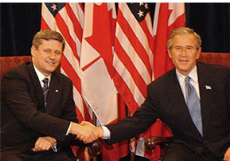
What do close advisors to Stephen Harper and George W. Bush have in common? They reflect the disturbing teachings of Leo Strauss, the German-Jewish émigré who spawned the neoconservative movement.

Strauss, who died in 1973, believed in the inherent inequality of humanity. Most people, he famously taught, are too stupid to make informed decisions about their political affairs. Elite philosophers must decide on affairs of state for us.

In Washington, Straussians exert powerful influence from within the inner circle of the White House. In Canada, they roost, for now, in the so-called Calgary School, guiding Harper in framing his election strategies. What preoccupies Straussians in both places is the question of "regime change."

Strauss defined a regime as a set of governing ideas, institutions and traditions. The neoconservatives in the Bush administration, who secretly conspired to make the invasion of Iraq a certainty, had a precise plan for regime change. They weren't out to merely replace Saddam with an American puppet. They planned to make the system more like the U.S., with an electoral process that can be manipulated by the elites, corporate control over the levers of power and socially conservative values...

Monday, January 23, 2006

ADEVĂRATUL EMINESCU

Active Information Media

Motto: “Suntem zăpăciţi, nu mai ştim ce voim, ce să facem, ce să primim, ce să respingem, în cine să ne încredem; nu ne mai înţelegem şi nu ne mai auzim unii pe alţii: ne trebuie o idee care să ne limpezească toate capetele şi care să ne împreune pe toti la lucru (…) De aceea alungaţi turma acestor netrebnici care nu muncesc nimic şi n-au nimic şi vor să trăiasca ca oamenii cei mai bogaţi; ei nu ştiu nimic şi vor să vă înveţe copiii şi n-au destulă minte pentru a se economisi pe sine şi vor să va economisească pe voi toţi.” (Mihai Eminescu)

PE 15 IANUARIE se sărbătoreşte şi acum cu aceleaşi declaraţii pompoase ziua de naştere a “Marelui Poet Naţional”, ajuns atât de faimos încât prea puţini îi mai cunosc astăzi opera. Incontestabil Mihai Eminescu a fost un vizionar, un om inteligent ce a depăşit cu mult gândirea epocii în care a trăit. Un om dotat cu talent scriitoricesc, un condei “periculos” pentru ignoranţi şi mincinoşi pentru că deţinea mijloacele de a-si propaga ideile şi a transmite mesajul de trezire naţională.

După ce Eminescu a fost redus la tăcere de aceleaşi forţe din umbră care manipulează şi astăzi frâiele politice ale lumii, opera sa a fost trunchiată şi “omorâtă” cu bună ştiinţă ca şi autorul ei. Considerăm “cazul Eminescu” unul dintre cele mai cutremurătoare exemple de manipulare prin intermediul mass-media şi al unor “experţi” istorici şi critici. Imaginea lui a fost cosmetizată atât în epocă cât şi pentru posteritate, opera trunchiată corespunzător şi mesajul alterat. De ce îl iubim pe Eminescu şi considerăm necesară reconsiderarea operei, vieţii, mesajului şi imaginii lui? Pentru că el a iubit extraordinar de mult România şi poporul român. Patriotismul a fost poate cea mai definitorie calitate a lui Eminescu. El a militat pentru trezirea şi emanciparea românilor şi de aceea a avut atât de mult de suferit. în epocă, el a fost acuzat de nebunie şi internat cu forţa pentru că ideile lui erau “periculoase”. Pentru posteritate, el a fost prezentat apoi doar ca un poet romantic.

Continuare »

Sunday, January 22, 2006

One Third of World's Population ­ 2.7 Billion People ­

Groundwater Aquifers Dropping at Alarming Rates and Conflicts Over Water Predicted

Washington, D.C. March 17, 1999 One third of the world's population will experience severe water scarcity within the next 25 years according to a new study by a leading global water organization. The study, which is the first to look at the complete cycle of use and reuse of the world's fresh water, finds that the water sources that supply the world's wells, lakes, and rivers are disappearing.

The study was conducted by the International Water Management Institute, a research center of the Consultative Group on International Agricultural Research (CGIAR), and appears in the March issue of the International Journal of Water Resources Development, a leading refereed journal on issues of global water resources. It is being released jointly with Future Harvest, a CGIAR-sponsored organization that educates the public about the links between global peace, the environment, and agriculture.

"Water scarcity is now the single greatest threat to human health, the environment, and the global food supply," said David Seckler, director general of the Water Institute and an author of the study with Randolph Barker and Upali Amarasinghe. "It also threatens global peace as countries in Asia and the Middle East seek to cope with shortages."

The study, Water Scarcity in the Twenty-First Century, projects water supply and demand for 118 countries over the 1990­2025 period. The study examines on a country-by-country basis not only how much water is withdrawn by the four major sectors that use water‹agriculture, industry, households, and the environment‹but also how much water remains to be used and how much returns to the ground to "recharge" aquifers. In recent years, as more water has been used to support growing populations in each of these sectors, there has been less water available to recharge groundwater supplies ...

Blue Gold: The Battle Against Corporate Theft of the World’s Water

Fresh water is quickly becoming big business, and a preserve of the wealthy.
The world's most fundamental and indispensable resource -- water -- is fast disappearing. In fact, a global shortage of water is looming as the most threatening ecological, economic, and political crisis of the twenty-first century.

And who is making the problem all the more severe? Big business.

In Blue Gold, activists and bestselling authors Maude Barlow and Tony Clarke document the rise of a rapidly proliferating enterprise enabled by recent international trade agreements: the privatization and commodification of water. They show how transnational corporations -- including venture capitalists, heavy industry, bottled water purveyors, and the two soft drink giants - are laying claim to the world's water, packaging it and selling it back to us at increasingly extortionate rates. And their practices are devastating ecosystems and depriving communities around the globe.

Water Apartheid

by MAUDE BARLOW & TONY CLARKE

[from the September 2, 2002 issue]

In South Africa, the only country in the world where people's right to water is actually written into the Constitution, the townships surrounding cities like Johannesburg and Durban have become hotbeds of resistance to water privatization. More than 10 million residents have had their water cut off since the government implemented a World Bank-inspired "cost recovery" program (which makes availability dependent on a company's ability to recover its costs plus a profit)--something that never happened in the worst days of apartheid. More than 100,000 people in Kwazulu-Natal province became ill with cholera recently after water and sanitation services to local communities were cut off for nonpayment.

Water is at the heart of every fight in this country, where the population is growing four times faster than the water supply and where women collectively walk the equivalent of going to the moon and back sixteen times a day to fetch water for their families. Access to water is a deeply political issue. Six hundred thousand white farmers consume 60 percent of the country's water supplies for irrigation, while 15 million blacks have no direct access to water. Labor unions like the South African Municipal Workers Union work with township activists to organize neighborhood-by-neighborhood resistance, re-hooking up the water supply and pulling out water meters. Such actions are a growing sign that citizens are prepared to challenge by action, when they cannot by law, injustices often originating with foreign-owned firms but implemented by their own governments.

Going Down the Road

by JIM HIGHTOWER

[from the September 2, 2002 issue]

Where's the Department of Homeland Security when we really need it?

I suppose that Homeland czar Tom Ridge is too busy with his color codes and his TIPS snitch patrols to notice or care that dozens of American communities presently find themselves under assault by foreign powers with names like RWE, Suez, Vivendi and Perrier. These global corporate raiders are grabbing for our most essential public resource: water. In just the past few years, such transnational conglomerates (along with such US players as Bechtel, T. Boone Pickens, Monsanto and, until recently, Enron) have quietly privatized all or part of the water delivery systems in Atlanta, Berlin, Bolivia, Buenos Aires, Casablanca, Chattanooga, Houston, Jacksonville, Jersey City, Lexington, Ky., Peoria, San Francisco and many other places (some of which have reverted to public ownership), plus laid claim to whole bodies of water, including the Midwestern Ogallala Aquifer, Blue Lake in Alaska and Canada's huge James Bay.

The water profiteers are seizing control by using weaselly politicians, campaign contributions, outright bribery, hordes of lobbyists, multimillion-dollar propaganda campaigns, NAFTA, the WTO, the IMF and the World Bank. An example of their reach can be found in the Water Investment Act moving through Congress, a generally worthy bill to provide funds for local cities to upgrade or expand their water systems. But industry lobbyists have tucked two little bombs into it, which remain in the House version: (1) a city cannot get federal financing unless it "has considered" privatizing its water system; and (2) private water corporations could get public subsidies for their water schemes.

The Grassroots Rebellion

While politicians--from Congress to city halls--have been bamboozled by privatization hucksters, who promise to bring "market efficiency" to the distribution of scarce water, ordinary folks have shown themselves to be way warier of surrendering public control. They know instinctively that the corporations are simply trying to grab a monopoly over a substance no one can live without, then squeeze maximum profits from it by firing experienced city workers, slashing wages, raising consumer rates, cutting service and ignoring repairs.

The great story here, untold by the establishment media, is of courageous rebels who are daring to step in front of the Great Corporate Water Rush. Meet two of these.

Hiroshi Kanno, 64, works a small farm in central Wisconsin. He stands only 5'6" tall, but--with his family and neighbors--he became a giant killer, beginning two years ago when the multibillion-dollar Perrier Group arrived in the towns of Newport and New Haven. It informed startled locals that it had a wondrous plan to begin continuous pumping of 500 gallons per minute of the area's pure spring water into its assorted bottles (Perrier's labels include Arrowhead, Calistoga, Deer Park, Oasis, Ozarka, Poland Spring and Utopia).

Who Owns Water?

by MAUDE BARLOW & TONY CLARKE

[from the September 2, 2002 issue]

"Water promises to be to the 21st century what oil was to the 20th century: the precious commodity that determines the wealth of nations."

As the World Summit on Sustainable Development draws closer, clear lines of contention are forming, particularly around the future of the world's freshwater resources. The setting of the summit paints the picture. Government and corporate delegates to the September meeting will gather in the lavish hotels and convention facilities of Sandton, the fabulously wealthy Johannesburg suburb that houses huge estates, English gardens and swimming pools, and has become South Africa's new financial epicenter. There, they will meet with World Bank and World Trade Organization officials to set the stage for the privatization of water.

At the same time, activists from South Africa and around the world with a very different vision will gather in very different settings to fight for a water-secure future. One such venue will be Alexandra Township, a poverty-stricken community where sanitation, electricity and water services have been privatized and cut off to those who cannot afford them. Alexandra is situated right next door to Sandton and divided only by a river so polluted that it has cholera warning signs on its banks. There could not be a more fitting setting for Rio+10 than South Africa, because neighboring Sandton and Alexandra represent the great divide that characterizes the current debate over water. Moreover, South Africa is the birthplace of one of the nucleus groups that form the heart of a new global civil society movement dedicated to saving the world's water as part of the global commons.

This movement originates in a fight for survival. The world is running out of fresh water. Humanity is polluting, diverting and depleting the wellspring of life at a startling rate. With every passing day, our demand for fresh water outpaces its availability, and thousands more people are put at risk. Already, the social, political and economic impacts of water scarcity are rapidly becoming a destabilizing force, with water-related conflicts springing up around the globe. Quite simply, unless we dramatically change our ways, between one-half and two-thirds of humanity will be living with severe freshwater shortages within the next quarter-century.

It seemed to sneak up on us, or at least those of us living in the North. Until the past decade, the study of fresh water was left to highly specialized groups of experts--hydrologists, engineers, scientists, city planners, weather forecasters and others with a niche interest in what so many of us took for granted. Many knew about the condition of water in the Third World, including the millions who die of waterborne diseases every year. But this was seen as an issue of poverty, poor sanitation and injustice--all areas that could be addressed in the just world for which we were fighting.

Now, however, an increasing number of voices--including human rights and environmental groups, think tanks and research organizations, official international agencies and thousands of community groups around the world--are sounding the alarm. The earth's fresh water is finite and small, representing less than one half of 1 percent of the world's total water stock. Not only are we adding 85 million new people to the planet every year, but our per capita use of water is doubling every twenty years, at more than twice the rate of human population growth. A legacy of factory farming, flood irrigation, the construction of massive dams, toxic dumping, wetlands and forest destruction, and urban and industrial pollution has damaged the Earth's surface water so badly that we are now mining the underground water reserves far faster than nature can replenish them.

The earth's "hot stains"--areas where water reserves are disappearing--include the Middle East, Northern China, Mexico, California and almost two dozen countries in Africa. Today thirty-one countries and over 1 billion people completely lack access to clean water. Every eight seconds a child dies from drinking contaminated water. The global freshwater crisis looms as one of the greatest threats ever to the survival of our planet.

Washington Consensus

Tragically, this global call for action comes in an era guided by the principles of the so-called Washington Consensus, a model of economics rooted in the belief that liberal market economics constitutes the one and only economic choice for the whole world. Competitive nation-states are abandoning natural resources protection and privatizing their ecological commons. Everything is now for sale, even those areas of life, such as social services and natural resources, that were once considered the common heritage of humanity. Governments around the world are abdicating their responsibilities to protect the natural resources in their territory, giving authority away to the private companies involved in resource exploitation.

Faced with the suddenly well-documented freshwater crisis, governments and international institutions are advocating a Washington Consensus solution: the privatization and commodification of water. Price water, they say in chorus; put it up for sale and let the market determine its future. For them, the debate is closed. Water, say the World Bank and the United Nations, is a "human need," not a "human right." These are not semantics; the difference in interpretation is crucial. A human need can be supplied many ways, especially for those with money. No one can sell a human right.

So a handful of transnational corporations, backed by the World Bank and the International Monetary Fund, are aggressively taking over the management of public water services in countries around the world, dramatically raising the price of water to the local residents and profiting especially from the Third World's desperate search for solutions to its water crisis. Some are startlingly open; the decline in freshwater supplies and standards has created a wonderful venture opportunity for water corporations and their investors, they boast. The agenda is clear: Water should be treated like any other tradable good, with its use determined by the principles of profit.

It should come as no surprise that the private sector knew before most of the world about the looming water crisis and has set out to take advantage of what it considers to be blue gold. According to Fortune, the annual profits of the water industry now amount to about 40 percent of those of the oil sector and are already substantially higher than the pharmaceutical sector, now close to $1 trillion. But only about 5 percent of the world's water is currently in private hands, so it is clear that we are talking about huge profit potential as the water crisis worsens. In 1999 there were more than $15 billion worth of water acquisitions in the US water industry alone, and all the big water companies are now listed on the stock exchanges.

Water Lords

There are ten major corporate players now delivering freshwater services for profit. The two biggest are both from France--Vivendi Universal and Suez--considered to be the General Motors and Ford of the global water industry. Between them, they deliver private water and wastewater services to more than 200 million customers in 150 countries and are in a race, along with others such as Bouygues Saur, RWE-Thames Water and Bechtel-United Utilities, to expand to every corner of the globe. In the United States, Vivendi operates through its subsidiary, USFilter; Suez via its subsidiary, United Water; and RWE by way of American Water Works.

They are aided by the World Bank and the IMF, which are increasingly forcing Third World countries to abandon their public water delivery systems and contract with the water giants in order to be eligible for debt relief. The performance of these companies in Europe and the developing world has been well documented: huge profits, higher prices for water, cutoffs to customers who cannot pay, no transparency in their dealings, reduced water quality, bribery and corruption.

Water for profit takes a number of other forms. The bottled-water industry is one of the fastest-growing and least regulated industries in the world, expanding at an annual rate of 20 percent. Last year close to 90 billion liters of bottled water were sold around the world--most of it in nonreusable plastic containers, bringing in profits of $22 billion to this highly polluting industry. Bottled-water companies like Nestlé, Coca-Cola and Pepsi are engaged in a constant search for new water supplies to feed the insatiable appetite of this business. In rural communities all over the world, corporate interests are buying up farmlands, indigenous lands, wilderness tracts and whole water systems, then moving on when sources are depleted. Fierce disputes are being waged in many places over these "water takings," especially in the Third World. As one company explains, water is now "a rationed necessity that may be taken by force."

Corporations are now involved in the construction of massive pipelines to carry fresh water long distances for commercial sale while others are constructing supertankers and giant sealed water bags to transport vast amounts of water across the ocean to paying customers. Says the World Bank, "One way or another, water will soon be moved around the world as oil is now." The mass movement of bulk water could have catalytic environmental impacts. Some proposed projects would reverse the flow of mighty rivers in Canada's north, the environmental impact of which would be greater than China's Three Gorges Dam.